
Warren Buffet is widely considered to be the greatest investor of our time, and someone who I personally have always admired and respected. A quote of his I read several years ago has always stuck with me: “Rule No. 1: Never lose money. Rule No. 2: Never forget rule No. 1.”
This is the exact mindset I take with all of my investments – principal protection! Why? Because losses hurt more than gains help. As an example, let’s look at two investments of $100,000 which suffer a loss, and the amount of gain required to claw back up to the original principal:
$100,000 x 20% loss = $80,000 (would require a 25% gain to get back to $100,000)
$100,000 x 50% loss = $50,000 (would require a 100% gain to get back to $100,000)
It takes a 25% gain to recover from a 20% loss, and a 100% gain to recover from a 50% loss. So, losses hurt more than gains help!
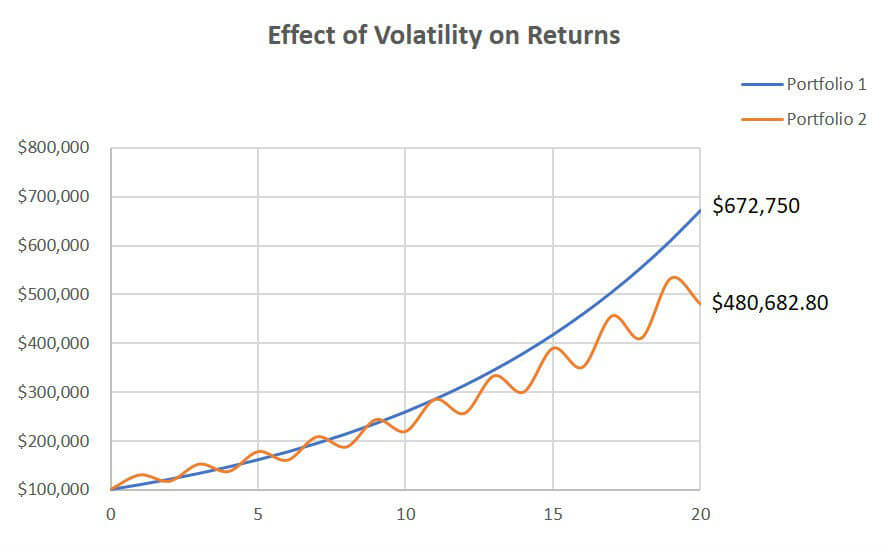
Therefore, it is important to minimize the downside of your investment – AKA the volatility! To further drive this point home, let us consider an investor involved with two very different $100,000 investments – one that is stable and increases at an average gain of 10%/year over 20 years (Portfolio 1) vs. another which is highly volatile and alternating between a 30% gain one year and a 10% loss the next year (Portfolio 2). Both portfolios have an identical average annual rate of return of 10%. Yet, the less volatile Portfolio 1 enjoyed 140% more growth than its highly volatile counterpart Portfolio 2!
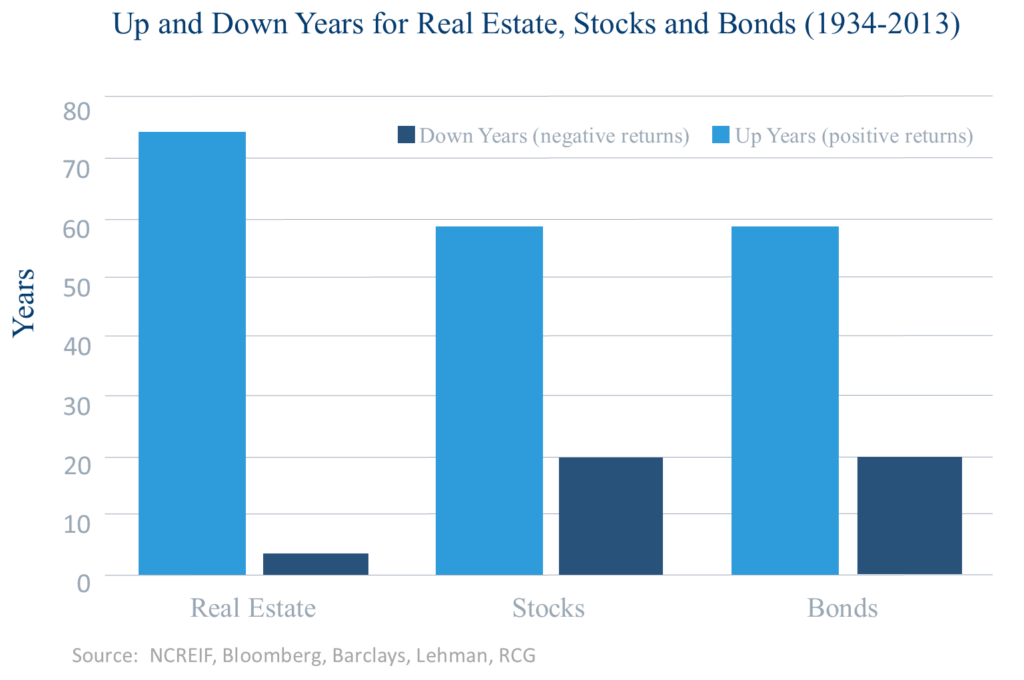
This is why it is imperative to avoid down years. Commercial multifamily has 3-4 times less down years than stocks and bonds – adding better returns with lower volatility.
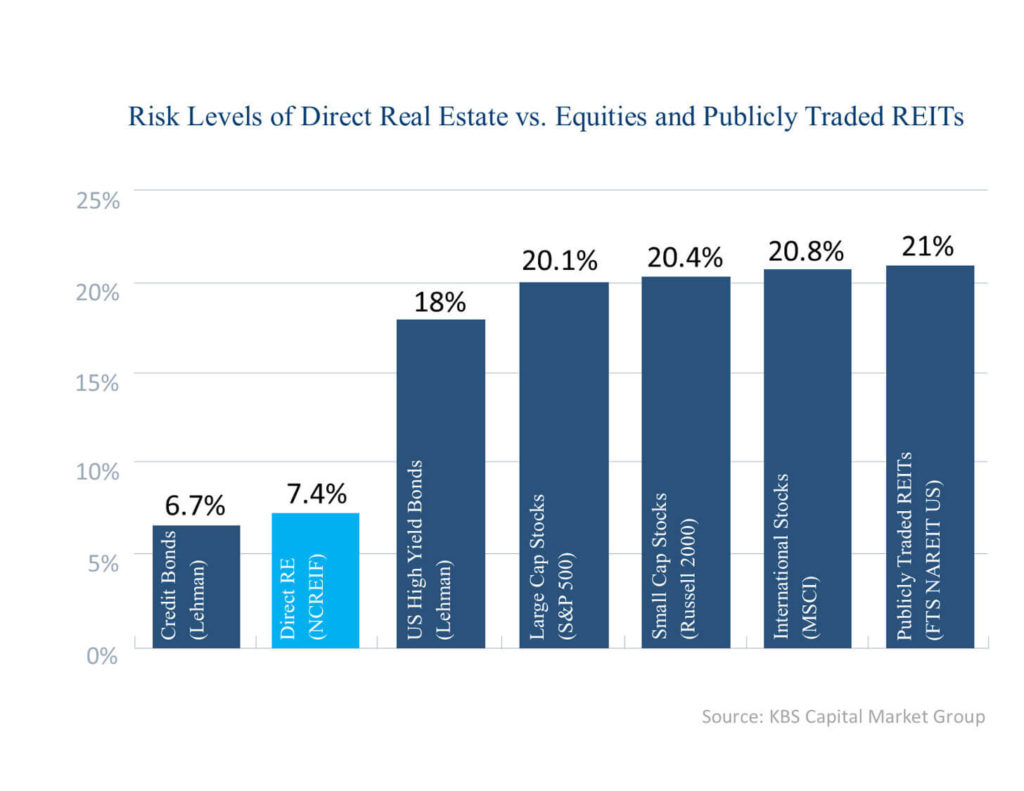
Commercial real estate has 3-4 times less risk than stocks and REITs.
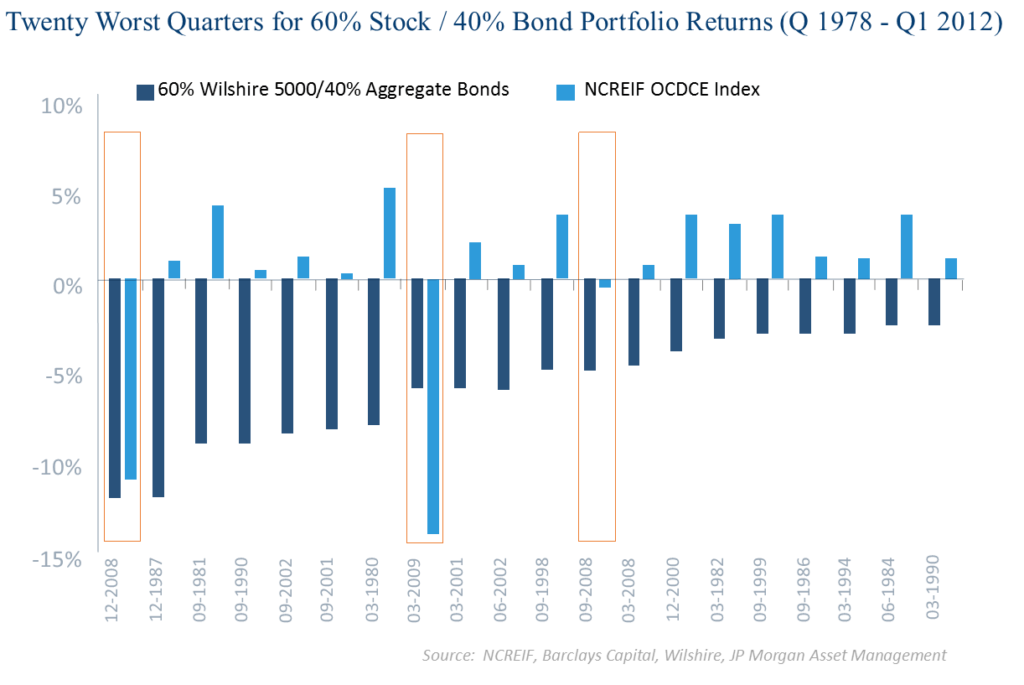
Below is further evidence to show the lack of correlation between the stable commercial multifamily investment and the highly volatile stock market. The below research shows the 20 worst quarters from 1978 – 2012 for a portfolio that is 60% stock/40% bond. How did direct commercial real estate ownership fare during those quarters? Quite well in fact – it was up 17 of those 20 down quarters!
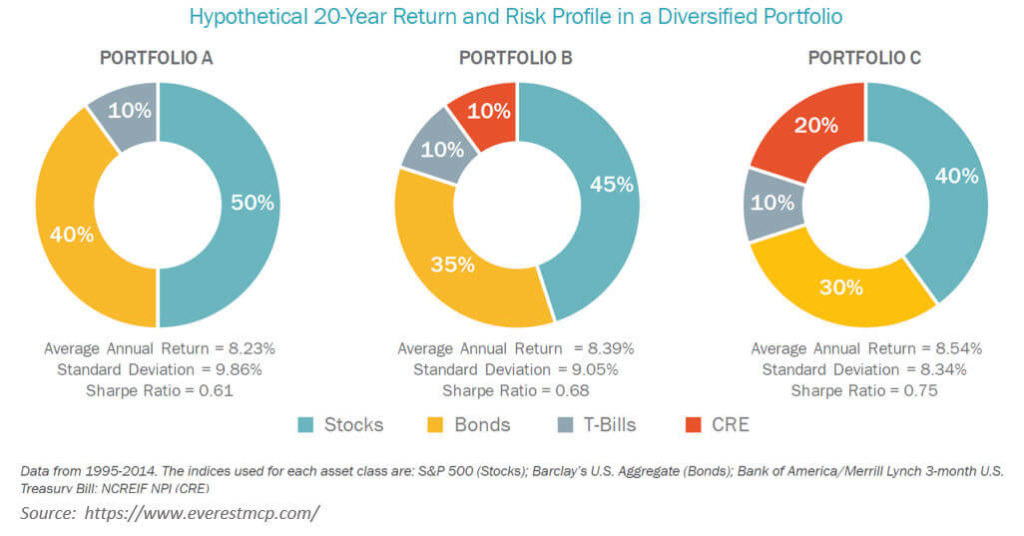
This is why so many stock investors are diversifying a portion of their portfolio into commercial multifamily real estate. It is highly uncorrelated to the stock market - and less volatile. Commercial multifamily real estate has a stabilizing effect on paper heavy portfolios. As illustrated below, a portfolio that diversifies into commercial real estate achieves better returns and stabilizes the portfolio (as seen by a higher Sharpe ratio). Consider the 20 year return/risk profile on a portfolio consisting of 50% Stocks / 40% Bonds / 10% T-bills when it is diversified into commercial real estate at either a 10% or 20% allocation...
To sum up, think about who already invests in commercial multifamily real estate (e.g., large banks, AAA life insurance companies) and the amount of due diligence and risk mitigation they have done to determine that investing in apartments is right for them. In the case of lenders, they are so confident about apartment buildings that they are willing to offer non-recourse lending.
If you are looking for an investment with a low risk profile and historically high returns that are uncorrelated to the stock market, then commercial multifamily real estate might be right for you.
See how LRG Properties can provide you with direct ownership in this asset class, and allow you to “Innervate Your Investments!”
To learn more about commercial multifamily real estate investing with LRG Properties, download your free report.