
I have not come across too many folks who have the mindset that “stocks and bonds” are the answer. Although most everyone is aware that real estate is a proven wealth generating asset class, many still have hesitation with getting started. The great majority of the time the root cause is in the following statement: “I don’t want to become a landlord!”
Early on in my career, I realized that success does in fact leave clues. The astute investor will serve himself well to follow these clues. I realized that over 90% of the Forbes 400 either created or maintain their wealth in real estate. Now that seemed to me to be a major clue! However, real estate is quite a broad term. As the old adage goes, “there’s a million ways to make a million dollars in real estate.” In fact, real estate is a multi-trillion dollar industry that represents the third largest asset class in U.S., behind only stocks and bonds.
In my search for an asset that provided stable cash flow with increased equity, under my direct control, the choice of commercial multifamily became an obvious one. To understand why, let’s take a look at just how commercial multifamily stacks up against what the average investor thinks of when he hears real estate – tenants, toilets, and 2 AM phone calls!...oh my!
1. Appreciation
This is probably my favorite reason to invest in commercial real estate – how it is valued. Let’s first focus on residential real estate, since this is likely familiar to most who own their own home. Residential real estate is appraised using the comparison model. So, your house is worth what comparable properties in size and location are selling for – this is out of your control and completely affected by the different phases of the residential real estate cycle.
On the other hand, commercial real estate (e.g., an apartment building) is valued based on the income produced by its operation. This is treated more like a business over which you DO HAVE CONTROL - unlike your home. The business model that is used is based off the following formula:
Value = Net Operating Income (NOI) / Capitalization Rate
So, before we go any further, let us define some of the components of the above formula. Your NOI is the income that is left after you subtract out all of your expenses and your mortgage amount. The capitalization rate is the percent return expected for a property acquired for all cash – in short, the smaller the capitalization rate, the more expensive the market.
Let us look at the scenario of comparing a duplex to a 200 unit apartment building. For simplicity, let us assume 100% occupancy in both cases. If we increase rents by $20/month, the duplex would see an increase in cash flow of $40/month or $480/year. Although the extra cash flow is nice, this does nothing to the value of your duplex because rent increases do not impact the "comparison appraisal model" in residential real estate. In fact, depending on where your property is in the residential real estate cycle, your duplex may possibly see a decrease in value despite your raising the rent.
In contrast, if we had a similar increase in rents of $20/month for each unit of our apartment building, we would have an increase in cash flow of $4,000/month or $48,000/year. In addition to the increased cash flow, we have also been able to drive up the value of our apartment and get rewarded for our ability to run the apartment efficiently. As an example, let’s assume we are in an 8% capitalization rate market...
Value = NOI / Capitalization Rate = $48,000 / 0.08 = $600,000
By raising the rents by $20/month, you have forced your property to appreciate by $600,000 in value! It’s always good to be in control and in the driver’s seat when it comes to your investments! Investing in commercial multifamily allows the investor to see rapidly expanding financial growth which just cannot be matched by residential real estate.
2. Leverage
In short, the purpose of leverage is to allow you to get higher returns than you could otherwise get if you paid for a property in full. Although the wealth accelerating effect of leverage just cannot be denied, those averse to real estate worry about risk. After all, leverage can be a double edged sword, right? But what if an investor could take full advantage of the upside of leverage while limiting its downside? This indeed is possible and can be accomplished by using non-recourse lending, which happens to be the industry standard for large commercial multifamily investments, but NOT for smaller residential lending. With non-recourse lending, if you default on the loan for any reason, your risk is limited to your capital contribution and nothing more! But you may be thinking, “why would a bank do this?” This just goes to further show how safe these investments are considered to be - even lenders are willing to provide a non-recourse loan given the safety profile of apartments. In essence, leverage makes real estate more lucrative than stock market investing, and non-recourse lending makes it much safer!
In fact, commercial multifamily is considered such a safe investment that it is one of the larger holdings of AAA rated life insurance companies. These companies must pay out death benefits, and they just cannot afford to risk their principal. As such, they see commercial multifamily as a perfect investment to obtain better results than their bond holdings, without having to take on significantly greater risk. So, offering non-recourse lending for commercial multifamily does seem to be a reasonable risk for banks to take!
3. Professional Property Management
While it is intuitive to most that real estate should be a part of every portfolio, the thought of toilets and tenants prevents many from taking action. I cannot blame these folks because you really should not being do so unless you have the time, expertise, and/or passion for managing tenants. However, for those who do decide to go into real estate, the usual route is to purchase a small residential property in close proximity to where they live. Some may consider a “mom & pop” property management firm, but quickly realize that these firms make only small profits from these smaller properties. As a result, they are forced to manage a high volume of these properties to make a reasonable living, which spreads them too thin to adequately look after your property. In the case that the investor takes on property management services himself, you are slave to the dreaded 2 AM phone calls!
For me personally, I wanted nothing to do with being a landlord. What many do not know is that there is a whole other world of property management that only focuses on larger commercial properties. These professional property management firms are composed of folks who actually went to college to study this stuff. They have systems in place that take advantage of economies of scale and bulk buying that the “mom and pop” firms just do not have access to. Commercial multifamily allows you to take advantage of professional property management so you DON’T have to be a landlord!
4. Economies of Scale
One of the key advantages of commercial real estate over smaller residential is Economies of Scale, which refers to the economic advantage gained as the scale of your investment gets bigger. To illustrate, let us take a look at the following example.
Let’s assume that we have one investment in a 2 unit duplex versus another in a 200 unit apartment building. In order to analyze this investment, we will use a metric commonly used in real estate known as breakeven occupancy (BEO). BEO is the percentage of units that must be occupied in order to break-even after paying expenses and debt service. If we assume that the BEO for both investments is 75%, we see that for the duplex, having just one vacancy puts us at 50% - below the BEO and with negative cash flow! In contrast, you would have to have 51 vacancies in your apartment building before you would start to see negative cash flow. Therefore, it is evident how economies of scale can provide quite the cushion to ensure that the investor makes money – especially since the more stable markets in the U.S. see 90-95% occupancy.
The power of economies of scale can also be seen with rents. Let us assume that we are going to raise rents $20/month. For our duplex investment, that is a total increase of $40/month or $480/year. In contrast, for our 200 unit apartment building, that translates into a total increase of $4,000/month or $48,000/year. And as we have seen from our discussion on valuation above, this increase of $48,000/yr will have an exponential effect on increasing the value of your apartment investment. Unfortunately, for the duplex, the $480/year increase in income does little to nothing for your duplex value.
As a final example, let us say that both investors were able to save $20/month in the water bill. Again, for the duplex that would equate to a total savings of $480/year, while the apartment building would see a total savings of $48,000/year. Since the NOI can be increased by either increasing revenue or decreasing expenses, we again see an increasing NOI leading to an increase in the value your apartment building. Unfortunately, the utility savings has little to no effect on the valuation of the duplex. It should be noted that utilities are just one of many expenses in which a small savings per unit can lead to a great deal of cash flow and an even greater amount of appreciation!
As an analogy, we are all familiar with the concept of buying bulk at Costco to get a lower price per unit. Similarly, with apartment investing, it is far less expensive per unit to build, operate, and maintain larger properties than smaller residential properties – Economies of Scale!
5. Volatility
The Sharpe ratio measures the return per unit of risk, and commercial multifamily has the best Sharpe ratio. In fact, commercial multifamily has the best risk adjusted return over any 5, 10, 15, 20, 25, or 30 year period compared to all other real estate asset classes, stocks, bonds, and REITs. Apartments have historically provided the best return of any other real estate asset class with less risk!
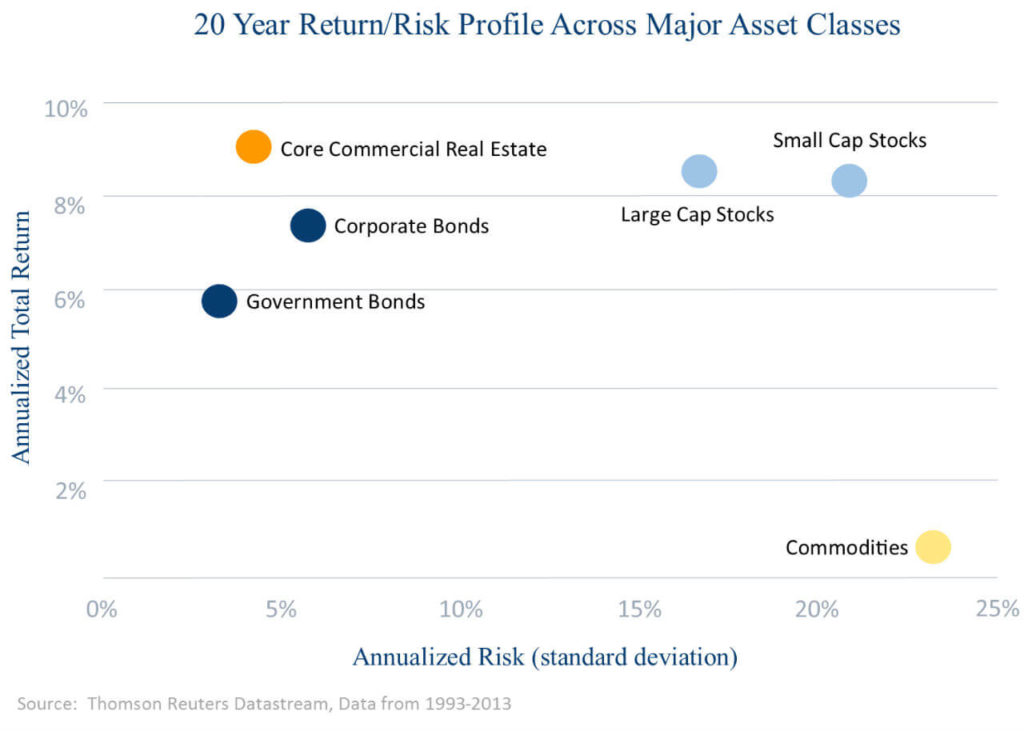
While high-quality commercial multifamily real estate is one of the most proven asset classes in history, some have shied away for a variety of reasons that include lack of information, insufficient experience, and insufficient capital - just to name a few.
Too many people buy smaller residential properties due to their lower price point. However, most burnout from management headaches coupled with little to no returns. The real money lies in going bigger!
See how LRG Properties can get you access to this asset WITHOUT having to become a landlord!
Our mission is to provide education, information, and access to apartment investing so that you may too "Innervate Your Investments!"
To learn more about commercial multifamily real estate investing with LRG Properties, download your free report.